
Packing for Travel in 1928–1931
By Stephanie Smith, MAFCA Era Fashion Committee
Taking a Weekend Trip to the Mountains
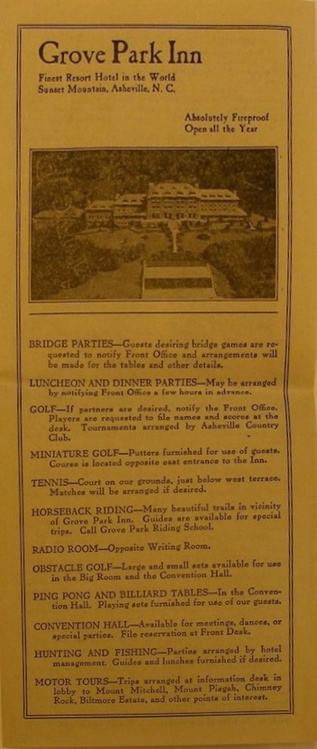
Winding through a mountain road through a private residential community, just outside of Pisgah National Forest in Western North Carolina, you will come to an opening where trees clear and the majestic Grove Park Inn appears. Although F. Scott Fitzgerald would not stay at the Grove Park Inn until 1935–1936, the Inn was already one of America’s premier mountain resorts during the Model A era. By 1928–1931, fashionable travelers arrived by automobile to enjoy scenic motoring, elegant dining, music, and the cool mountain air.
Fitzgerald himself stayed in rooms 441 and 443 while his wife Zelda received care at a local hospital. During this difficult period, he continued writing short stories and essays overseeing the Inn’s entrance while noting and detailing the interactions, conversations, personalities and fashion of fellow guests.
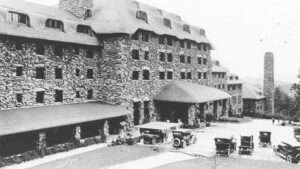
The Grove Park Inn became an important social hub; with an itinerary and recommendation list for visitors and locals alike. And although a lot of people generally like to think that every woman donned a glamourous flapper ensemble all day long, the reality was women had many dress styles and those very dress styles would have been packed for a trip here in the Model A era.
The Grove Park Inn offered various activities throughout the day, from sports and games to scenic motoring, to simply enjoying a visit to the local town and sites; to formal dinner and fun-filled dances with orchestras and jazz bands – a well appointed woman would have been packed and prepared to dress for any occasion.
What Was in Her Suitcase?
A fashionable traveler would have packed these items:
- Morning/day dress
- Afternoon tea dress
- Formal dinner gown
- Evening dancing dress (if different)
- Silk stockings
- Step-ins and camisole
- Corset or corselette
- Brassiere
- Cloche hat
- Driving gloves
- Evening gloves
- Handbag(s)
- Compact powder
- Lipstick
- Perfume
- Beaded necklace
- Evening wrap
- Low-heeled walking shoes
- Evening pumps
Morning Dress
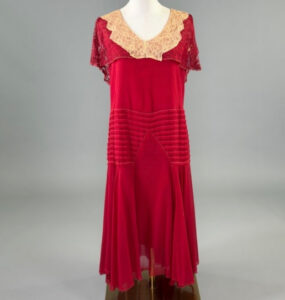
This dress is an example of a casual dress, that a woman would wear while out running errands, brunch, sight-seeing while on a motor tour of the Blue Ridge Parkway, or perusing through local shops.
Day dresses were made in a variety of fabrics and, although still stylish, were generally more practical and less ornate than evening attire. The lace collar on this example adds a feminine decorative detail.
As twilight settled over Sunset Mountain, guests retired briefly to their rooms to exchange practical daytime attire for elegant evening dress. Soon the Great Hall and dining room filled with silk, satin, velvet, and shimmering beadwork. Following dinner, the orchestra struck up the evening’s first dance, and many couples remained well into the night, enjoying the music that defined the closing years of the Jazz Age.
Afternoon Dress
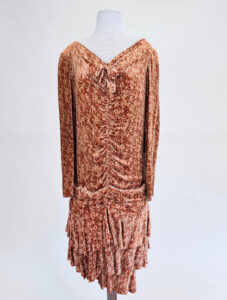
This dress is a perfect example of an Afternoon dress with a softer print, velvet texture and feminine decorative details. This dress would have been ideal for tea, bridge, or visiting with friends at an afternoon social on the terrace.
Dinner Gown (Formal)
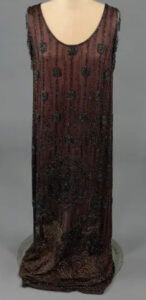
Rich fabrics and intricate beadwork made formal dinner gowns the highlight of an elegant wardrobe. Reserved for the most refined occasions, gowns such as this would have been worn to dinner in the Grove Park Inn dining room before an evening of orchestra music and dancing.
Evening Dress (Dancing)
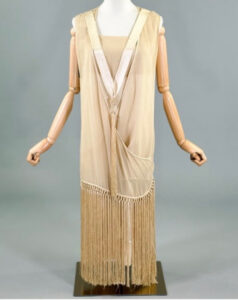
By the late 1920s, evening attire had become an expression of both elegance and modern style. Lightweight silk fabrics, flowing fringe, and elongated silhouettes were designed not only to flatter the wearer but also to accentuate movement while dancing popular steps such as the foxtrot and waltz.
Please note, all dresses shown are part of author’s private collection.
Even to this day, the Grove Park Inn has a Gin and Jazz event in late September each year, remembering F. Scott Fitzgerald and the late Jazz age.
Usually planned around Fitzgerald’s birthday September 26th, guests can experience tours of the very rooms Fitzgerald stayed in. Guests are served food from the late 1920’s, spirits and fun cocktails. They have a live Jazz band, and also feature board games. Dressing in period-attire is strongly encouraged.
Saturday is a day when guests are encouraged to explore and venture out, followed by a 1920’s-style brunch on Sunday – an itinerary very similar to the way a weekend during the Model A era would have been.
Based on the old saying, one has to wonder “The more things change, Can they really stay the same?” I personally find it to be true at the Grove Park Inn. And I hope others share in my sentiment to find it not only nostalgic but necessary; in walking the same halls nearly a century later to give a deeper appreciation for the lifestyle – and the fashions – of the Model A era.
References
- Omni Hotels website.
- Seth’s Antiques.
- The Metropolitan Museum of Art. “Twentieth-Century Silhouette and Support.” The Metropolitan Museum of Art. Paul Poiret, Dress, 1928, silk and glass.
- Lois Long, “Feminine Fashions,” The New Yorker, September 21, 1929.
- The Metropolitan Museum of Art — Peggy Hoyt, Evening Dress, Spring/Summer 1928.
- The New Yorker, “On and Off the Avenue,” March 29, 1930.
- Photo Credit Nicole Seitz.
- Photo Credit Stephanie Smith (author).