
By Brian Carlson
The Iconic Snap-Brim Fedora Hat
Advertised in 1928 as being “Blocked in one of the most approved styles.” this
description reflects the legacy of a hat with a history spanning more than a century.
During the Model A Era the fedora was the favorite of men ranging from the fashionable
young collegiate to the conservative head of the family. It was the most adopted of
available hat styles both for social daytime and business occasions. Its popularity can
be attributed to a rugged workable design combined with a perfection of curvature and
dimension.
During the Model A Era social expectations dictated that the well-dressed gentleman’s
wardrobe included hats and caps appropriate to their circumstance. The wearing of a
head covering upon leaving home was the accepted practice, only to be removed
indoors as appropriate or being engaged in conversation with women. Further, it was a
strong economic statement about the wearer and status symbol.
The fedora is a soft felt hat with wide brim and features a prominent crown. Its styling
descends from the traditional brimmed hat worn as part of the customary costume of
Tyrol, a mountainous region of the Austrian Alps. The hat’s name was derived from
French dramatist Victorien Sardou’s successful 1882 tragic romance stage play Fedora
which starred the extremely popular actress Sarah Bernhardt as the heroine Lady
Fedora. To the delight of her numerous French, German, and English fans, she was
reported to have worn a stylish soft felt hat replete with a crease in the crown which the
fans quickly emulated in their own wardrobes. The fedora then made its way across the
Atlantic and was being advertised in New York by 1884 as a newly offered hat style.
It is fair to state that the early fedora could have easily become a footnote in history, but
subsequent events interceded. Italian hatmaker Giuseppe Borsalino, his legacy still a
world-wide force in the hat world, turned his attention to the then new hat. His creative
genius transformed it by undertaking innovative improvements resulting in the ‘modern
fedora’ styling available in the Model A Era. Borsalino’s styling improvements met with
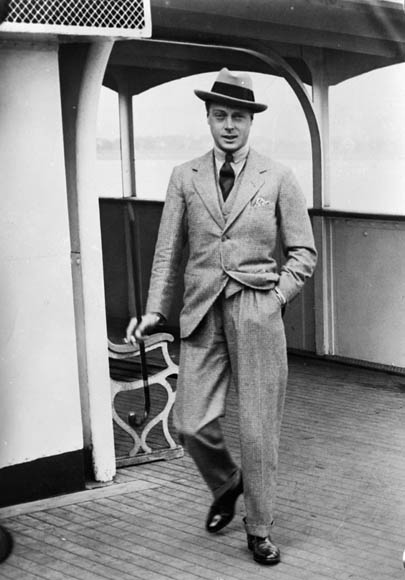
ever increasing popularity including the attention of England’s Prince Edward VIII, a
fashion icon in his own right. A 1924 visit to the United States influenced the fashion
world when he wore a fedora with dressy suits. Americans embraced the fashionable
boldness of a royal socialite. Sears, Roebuck and Company also noticed; mass
production of the fedora was quickly undertaken. This resulted in the eroding popularity
of homburg and derby hats.
The fedora was the most popular men’s hat of the Model A Era. Its style remained
constant during those years, as did all other aspects of men’s hats. This was in sharp
contrast to the constantly changing contemporary designs encountered by women.
Reinforcing the popularity of the fedora was its fashionable choice in contrast to the
previously stiffer hats, enhanced versatility and the emerging influence of theatre
palaces that portrayed Hollywood’s leading men wearing a fedora. This suggested that
the purchase of a good quality hat would ensure years of service with no fear of
becoming dated.
While original fedoras can be sourced (online, antique stores or swap meets), there are
often challenges as to condition and fit. Fortunately, there are many quality fedora hats
for sale through haberdashers or online. The challenge is to select a hat that closely
adheres to what was available during the Model A Era.
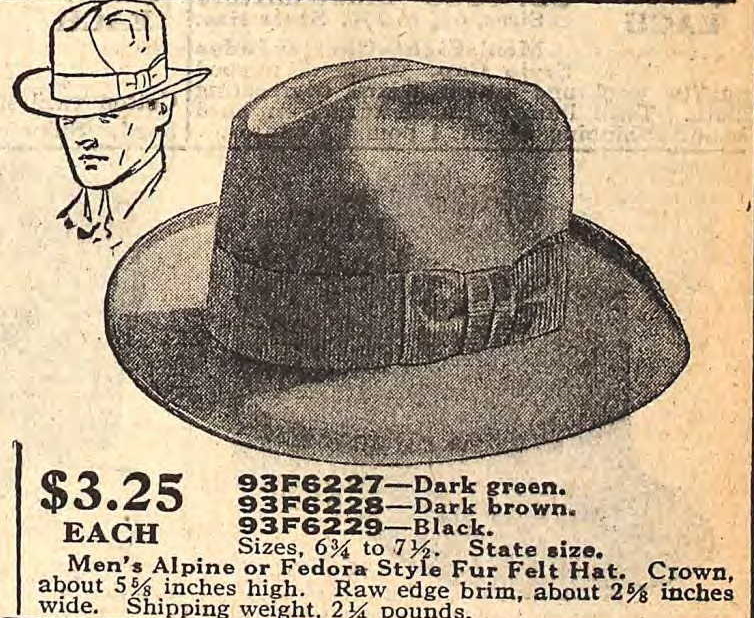
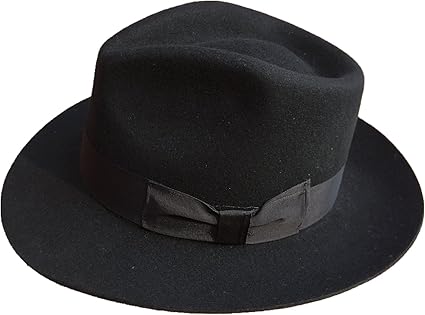
The ’modern fedora’ of the Model A Era encompasses several key stylistic components
and materials. The Fedora is fashioned from a soft felt material: fabric made from
animal fur such as rabbit, or wool, processed to form a smooth or napped finish. The felt
is typically dyed black, brown, or gray with blue, green and tan sometimes at offer. A
prominent crown of over five inches features a crease (also termed a bash or dent) in
the form of a lengthwise trough but also commonly available is the teardrop (also known
as the ‘C’) style. In addition, the crown has a “pinch” at the front sides, claimed to have
been originated by Borsalino in order to facilitate a gentleman undertaking to doff his
chapeau. A one and 3/4-inch-wide grosgrain ribbon featuring a bow completes the
crown.
The brim of a fedora is also a defining feature. There are three distinct edge finishings
associated with the fedora style: raw or unfinished, finished with a sewn overwelt or
underwelt or bound with grosgrain ribbon. These finishings allow the brim to be worn in
a variety of angles resulting in the ‘snap-brim’ designation. Width of hat brims range
from two and 3/8 to two and 2 5/8 inches. Rounding out the construction of the hat is the
lining. Quality products feature satin or silk material, often with a top plastic protector,
combined with a leather sweatband. An unlined fedora with fabric sweatband is a
summer alternative.
The fedora hat continues to be an enduring fashion favorite. This popularity still makes it
possible for a gentleman to acquire an authentically styled Model A Era hat as a
fundamental component of his everyday period wardrobe.