

Q: I am trying to reduce/eliminate leaks under my 1930 deluxe coupe. Currently, my transmission leaks on both ends (front and back). I would like to install Mitchell’s “Real Deal Seals” but looking at my reverse idler shaft, it does not stick out past the rear of the housing, but is flush as pictured. In your opinion is this shaft wrong, modified, or installed wrong?
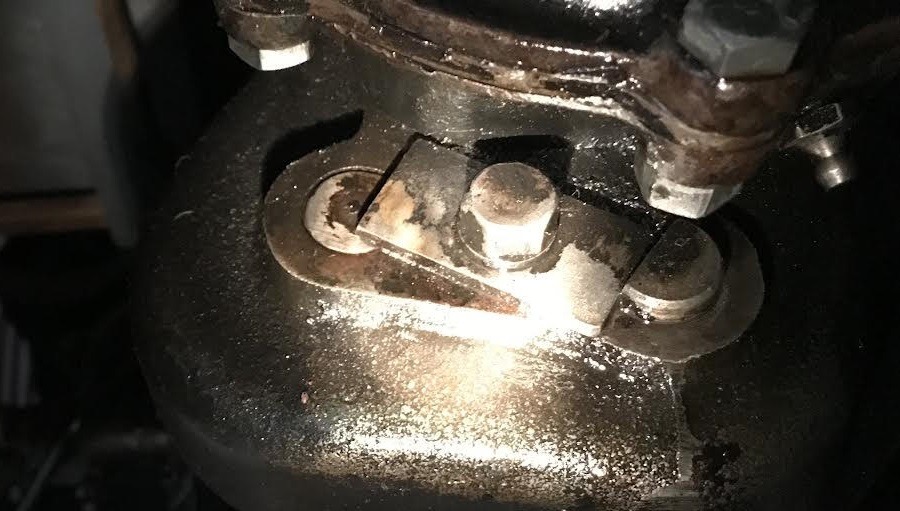
– Daily
A: Hi Daily! That definitely looks to be installed wrong, or perhaps backwards. The only way to know for sure is to remove that idler shaft and check but you’ll need to remove the transmission to do that. That’s a decision only you can make depending on how bad the oil leak is. Good luck to you.
– Ed Tolman
Q: I recently bought my first Model A and want to change the oil. I went to my local club meeting for the first time and everyone there tells me to use 15-40 diesel oil. I’ve watched (Model A) videos and like the idea of using synthetic oil as I’ve always used it in my regular cars. My only hesitation is that I’ve read that synthetic oils can degrade the seals in the engine. My engine was rebuilt before I bought it and has approximately 3000 miles since rebuild. Can I assume since it was recently rebuilt, that the seals were replaced with modern materials that shouldn’t be affected by the synthetic oils? I have no way of contacting the gentleman that rebuilt the engine to find out.
– Scott
A: Remember that when the Model A was new, oil and gasoline were much poorer than today’s products. Since today’s products are so much better, pretty much ANY motor oil you choose will be superior to those available almost 100 years ago. The guideline on what oil to use boils down to this issue: Has your engine been recently overhauled or rebuilt? or does it have 50,000 or more miles on it?
If the engine has recently been worked on, as in your case, ANY current motor oil is fine, either detergent or non-detergent (I suggest detergent). Depending on where you live, the viscosity will vary. Most of us who drive year long use 10-30 or 10-40. In colder climates, you would adjust that to suit.
If the engine has a gazillion miles on it, stick to non-detergent oil so that impurities get dropped into the oil pan and generally aren’t circulated through the engine. And change your oil at least 1000 miles or fewer. As for the synthetics, it probably won’t hurt any recently rebuilt engine (they are all detergent oils). Since your engine was rebuilt recently, I’m confident that any good oil won’t hurt the gasket or the seals.
– Rick Black
A: I agree with Rick’ answer 100%. Let me also add that the stock Model A engine is not a pressurized system, and it relies on some oil dripping down passageways to lube the main crank bearings. If using thicker oil, the main bearings receive less oil, especially when cold. Stick to 10-30 and you’ll be fine. Like Rick, in a newly rebuilt (clean inside) engine, I also prefer the detergent oils. Pretty much any of the modern 10-30 oils is WAY better than the oil that came with the car new.
– Paul Shinn
Q: I inherited this 1929 5 window coupe last year after my brother passed. Brought the car home 2 months ago and have started to bring it back after sitting in a garage neglected for 15 yrs. The engine runs really good except the overheating part.
Coolant was drained and I replaced the head gasket as I am sure this had never been touched. Torque was very poor and gasket looked quite bad. Head and block were cleaned and grossly checked for trueness. Both appeared to be really level. No warpage. Head gasket replaced and torqued slowly in increasing increments up to final 55 ft./lbs. Engine warmed and allowed to cool overnight and the head re-torqued.
Fresh water added and engine started but after 10 mins water began pouring from the overflow tube and spitting over top of the radiator neck. My opinion is to consider the radiator, either having it professionally flushed or re-cored or purchasing a new one. Your opinions will be greatly appreciated.
– Kevin
A: Since the car was sitting for many years, the radiator is probably not in the best of shape. My first move would be to get a good radiator shop to replace the core, keeping your upper and lower tanks. Trying to clean it out now will probably only come back to haunt you. Do it right. New radiators are very expensive!
– Rick Black
Follow up: The radiator was in fact the real issue to the overheating. I had suspected but was working my way up the expense ladder. Radiator has been re-cored with a heavy duty 11 fin per inch core. It works perfectly! A picture and comment from the specialist showed that approximately 60% of the tubes in original core were totally blocked.
Again, thank you for your assistance! – Kevin
